
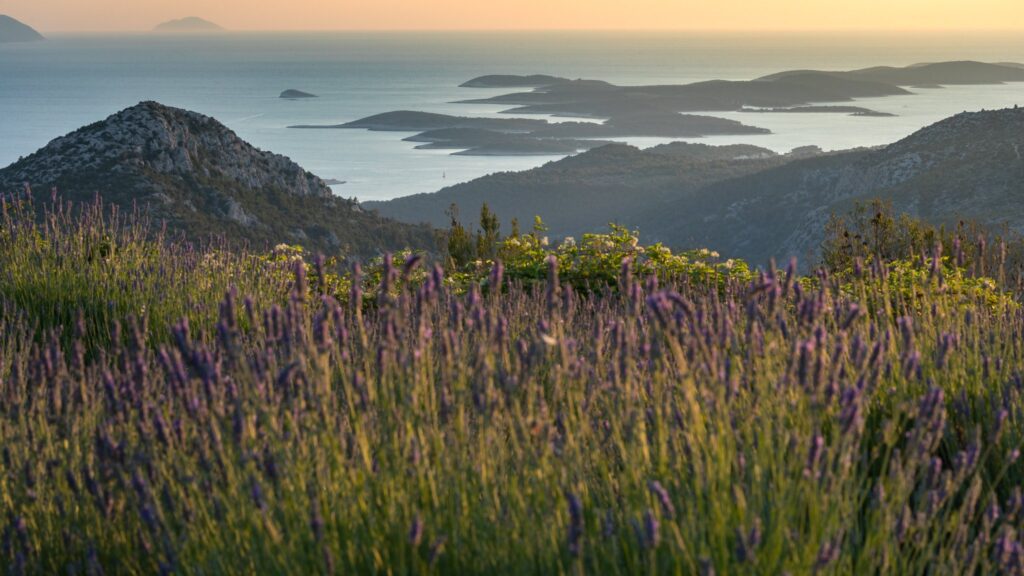
Lavender is one of the strongest visual associations with Hvar today. It appears on postcards, in travel articles, and across the island as something almost self-evident – as if it has always belonged here.
But it hasn’t.
Unlike wine and olive oil, which form the deep agricultural foundation of the island and stretch back thousands of years, lavender is a relatively recent addition to Hvar’s landscape. That is precisely what makes its history so important. It is one of the rare cases where we can clearly trace how a crop was introduced, how it expanded, and how it reshaped both land and life within a single century.
Arrival and life of Hvar lavender is a story of deliberate introduction, rapid success, and structural decline – followed by transformation into something that today exists more as part of our identity than such a big part of the economy of Hvar Island. Without lavender on Hvar, maybe there would be no tourism here in the way we have it now. Maybe we’d be living in a bigger city, chasing 9-5 jobs instead of living on our home island where we get to show you our culture through Hvar4You.
Hvar Before Lavender: A System Already in Balance
Before lavender appeared, Hvar was already a fully formed agricultural system built on two pillars: vineyards and olive groves.
The history of wine on Hvar shows how the island connected itself to the wider Mediterranean through trade, adapting production to external demand and expanding wherever conditions allowed. At the same time, the history of olive oil on Hvar reveals a completely different logic – one based on long-term resilience, household stability, and the ability to endure even when wider systems failed.
Together, these two created balance.
Wine was outward-looking, dynamic, and economically ambitious. Olive oil was inward-looking, stable, and essential for survival. By the early 20th century, however, this balance was under pressure. Vineyards had already experienced major disruptions, and the island needed something that could make use of land that was too poor, too dry, or too exposed for reliable grape or olive production.
Lavender entered Hvar not as a replacement, but as a solution to that exact problem.
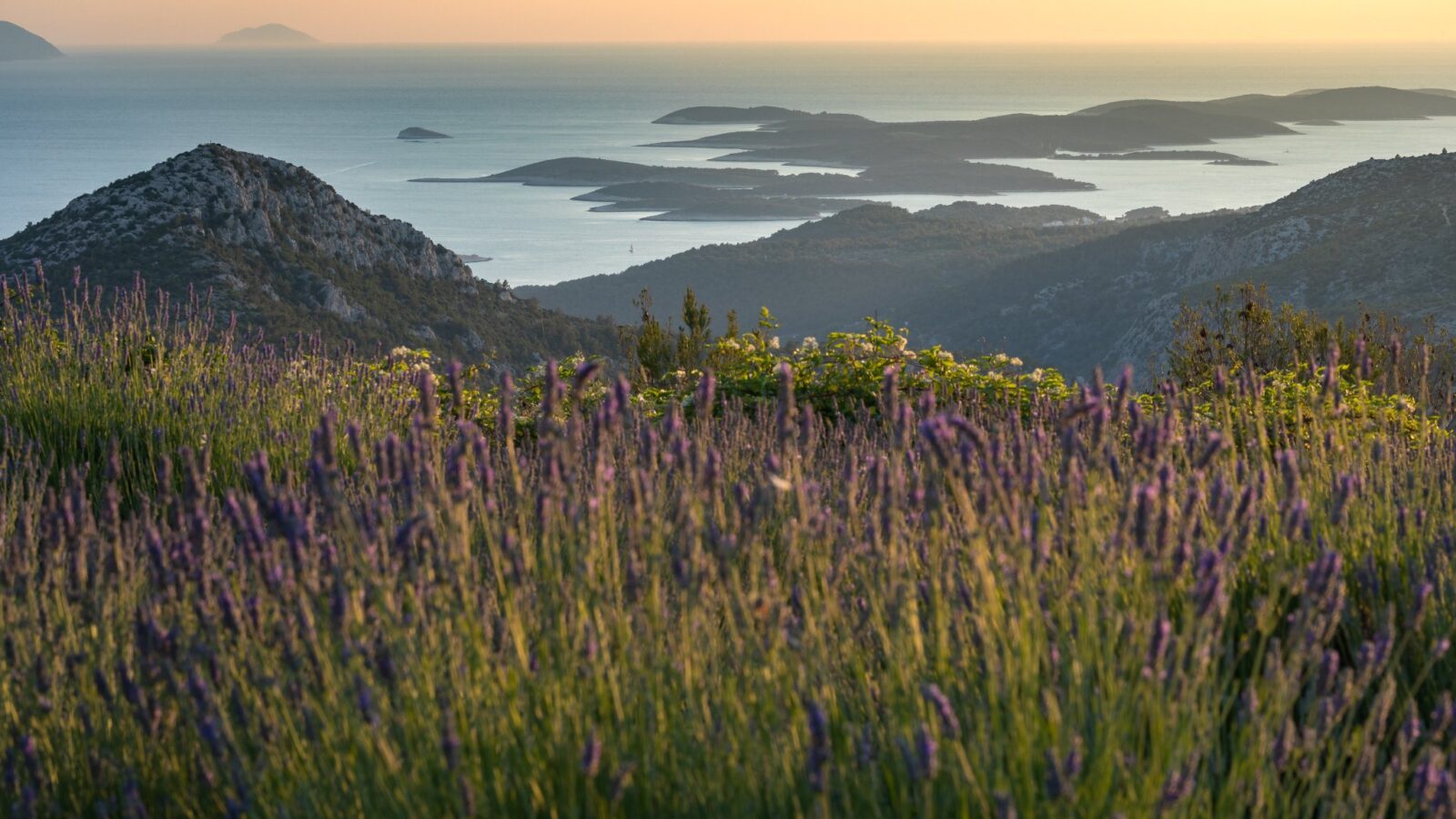
The Introduction of Lavender to Hvar: A Planned Intervention
Lavender did not arrive on Hvar through tradition or gradual diffusion. It was introduced intentionally.
In 1928, agronomists Antun Bradanović and Frano Tabain brought lavender to Hvar as part of a broader effort to improve agricultural productivity and stabilize rural income. This was not an isolated experiment. Lavender had already shown success in comparable Mediterranean environments, including nearby islands such as Vis, from which knowledge and planting material were transferred.
Lavender could grow on shallow, rocky soil, tolerate intense sun exposure, and survive with minimal water. More importantly, it produced essential oil that could be exported. In a period when agricultural systems were struggling with instability and limited profitability, lavender offered something rare: a crop that combined low input requirements with clear market value.

Expansion of Lavender Across Hvar Island: From Velo Grablje to the Interior
Once introduced, Hvar lavender spread quickly, particularly in areas where traditional agriculture had limited reach.
The centre of this expansion was Velo Grablje, a village located above Hvar Town, where conditions proved ideal for cultivation. From there, Hvar lavender fields extended across central part of the island, covering areas around Brusje, Zastražišće, Gdinj, and surrounding inland zones where terrain was too demanding for more intensive crops.
Lavender filled specific gaps in the agricultural landscape. It allowed farmers to utilize land that had previously been underused or economically unviable.
By the mid-20th century, Hvar became one of the most significant lavender-producing regions in Europe, responsible for a substantial share (at one point 8%) of global lavender oil production. At that scale, lavender became a defining economic activity, shaping seasonal work, village life, and the visual identity of the island itself.
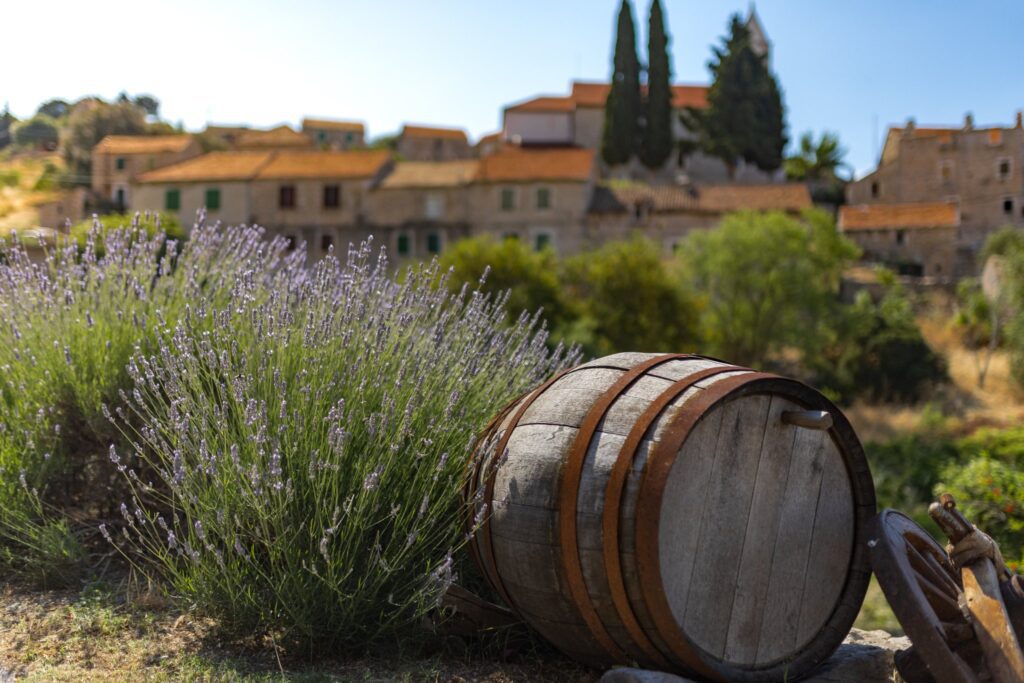
What are the Differences Between Hvar Lavender and French Lavender?
Comparisons between Hvar and Provence are common, but often misleading.
Hvar lavender is not primarily Lavandula angustifolia, the variety associated with high-end French perfumery. Instead, the dominant plant on Hvar is lavandin, a hybrid known as Lavandula × intermedia, with Budrovka, its local form, making a smaller part of the remaining lavender fields on Hvar.
Lavandin produces significantly higher yields of essential oil and is more resistant to difficult growing conditions, which made it suitable for large-scale cultivation on Hvar’s terrain. Its scent is stronger and sharper, with higher camphor content, making it less suitable for luxury perfume production but highly effective for medicinal use and functional applications.
This explains the direction Hvar took.
While regions like Provence focused on refining lavender into a luxury product, Hvar developed a system based on efficiency, durability, and broader usability. Cultivation remained largely manual, fields were irregular and fragmented, and production adapted to the land rather than reshaping it. The same as the history of Hvar wine and history of olive olive oil on the best Croatian Island. In a terrain as harsh as this, in the past, we had to adapt to nature and listen to it, as a teacher, mother, but also as our child.
And because we reshaped nature just enough to let us live from it, the island is still magnificent wherever you look. Even the steep slopes around Velo Grablje that used to be fully purple during summers when our dads were kids still look mesmerizing. Maybe there’s no significant agricultural production on them anymore, but the dry stone walls still serve as monuments to previous generations. Not only that, they serve as the monument to Hvar lavender itself, like an empty shell – a permanent reminder that life once thrived there.
Production and Daily Life
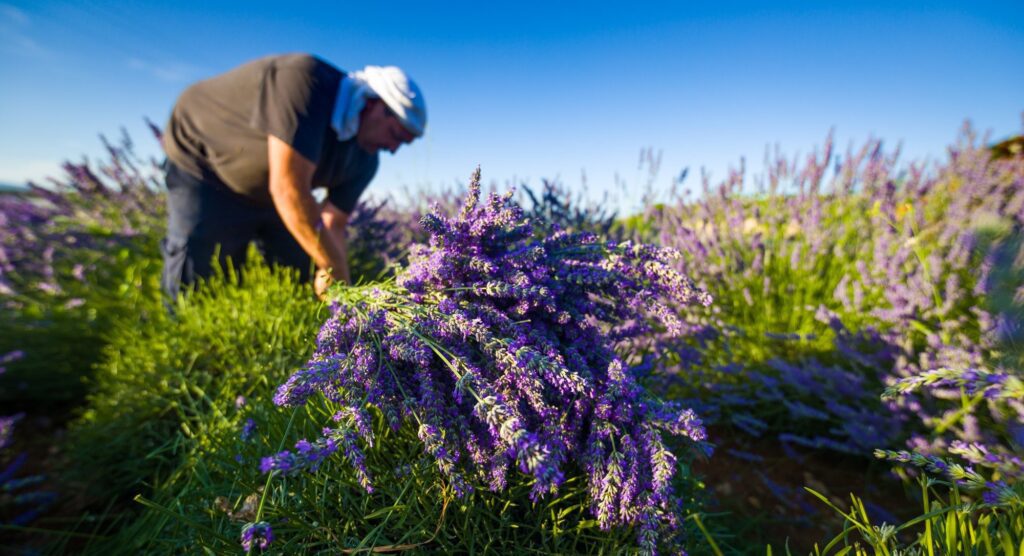
Hvar lavender production followed a clear, structured process, but one deeply tied to manual work and local coordination.
Harvest had to be timed precisely, at the moment when the concentration of essential oils in the plant was highest. This required experience rather than technology. Once cut, lavender was transported to distillation sites, where oil was extracted through steam distillation.
Unlike olives or grapes, which often remained within local consumption systems, lavender oil was immediately oriented toward storage and transport. It was stable, lightweight, and easily tradable, which allowed it to move beyond the island without losing value.
Lavender introduced a new rhythm. It required cooperation between families, and connected isolated rural areas to wider markets. It did not replace existing agricultural systems, but it added a new layer – one that was faster, more flexible, and directly linked to external demand.
Velo Grablje Today: From Hvar Lavender Hotspot to Memory
Velo Grablje remains the symbolic centre of Hvar lavender, but its role has changed.
Once a highly active production hub, the village is now largely depopulated. However, it has not been abandoned in meaning.
Each year, the Lavender Festival in Velo Grablje revives the village, bringing together locals and tourists through cultural, fun, and education programs that preserve knowledge of traditional cultivation and distillation. Demonstrations of harvesting, oil extraction, and product preparation reconnect the present with a system that once defined the area.
Alongside the festival, local initiatives such as the herbs museum and community organizations continue to maintain the memory of Hvar lavender as a working crop rather than just a visual symbol. Even references like NK Lavanda reflect how deeply the plant entered local identity.
Fun fact about Hvar: Our island is the only island in Croatia with an official football league. NK Lavanda plays every year, they are not great when it comes to results, but they play with hearth, they keep Velo Grablje proud, and they have the best looking jerseys – green shorts with purple shirts – another way to honor the plant that shaped their village.
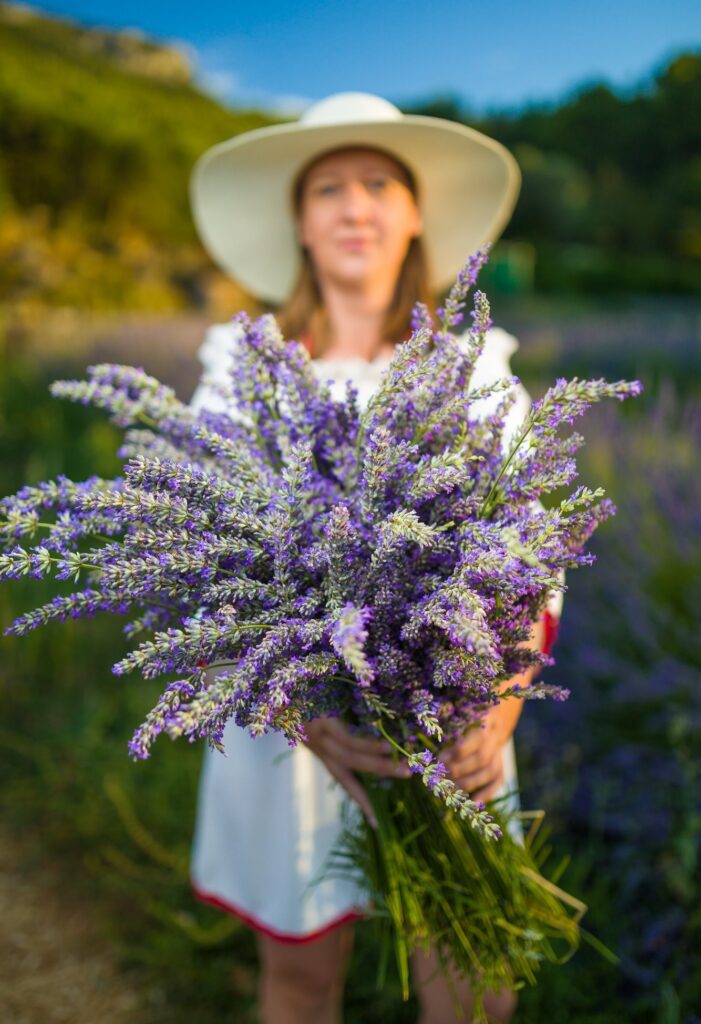
Decline of Lavender on Hvar Island: Structural, Not Sudden
Hvar lavender didn’t “disappear” from the island because it failed. It declined because conditions changed.
Wildfires destroyed large areas of cultivated land, and because lavender is highly flammable, recovery was limited. At the same time, tourism began offering higher and more immediate economic returns than agriculture, particularly in coastal areas.
Perhaps most importantly, demographic changes reduced the available workforce. As younger generations left rural villages, the labor-intensive system required for lavender production became unsustainable.
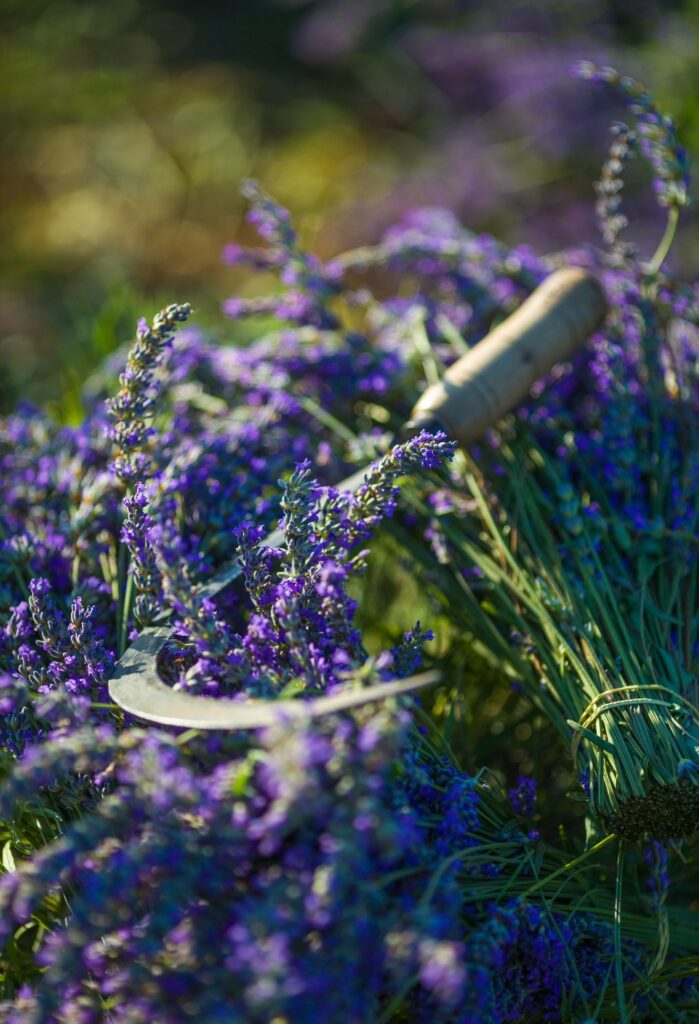
Hvar Lavender Today
Today, lavender occupies a different position within the island’s structure.
It is no longer a primary agricultural driver, and it does not compete with wine or olive oil, which continue to function as both economic and cultural systems.
Instead, lavender exists as a preserved landscape, a cultural reference, a reason to book a Lavender tour. Small-scale production continues, particularly in traditional areas, but its meaning has shifted. It is no longer about the quantity. Now it’s about quality and keeping the tradition alive. Now it’s about pride in what we are, what we had to survive and how we did it, partially thanks to lavender.
Lavender Still Defines Hvar Island, it Will Define it Even when Donkeys Grow Wings
Lavender is not the foundation of Hvar. It does not carry the same historical depth as wine or the same structural importance as olive oil.
But it represents something equally important. It shows how the island responds to change.
It demonstrates how knowledge can be transferred, applied, and scaled within a specific environment. It reveals how quickly a landscape can be reshaped when the right crop meets the right conditions. And it shows how agricultural systems can disappear economically while remaining deeply embedded in cultural identity.
So even though lavender came to the island centuries after wine and olives, it left a mark that will be visible even when the last of Hvar people smells this purple fairy for the last time.
And we have more than 2000 years of proof that life on Hvar keeps thriving no matter what…
We’re confident that some owner of a local Hvar tourist agency in 4026 will write about the history of lavender on Hvar and be proud to say that Hvar lavender arrived 2000 thousand years ago.
And he’ll be even more proud that we managed to preserve such treasure for such a long time… Who knows, maybe his Lavender tour on Flying Donkeys might be the best tour on Hvar in 4026. But in 2026, the best way to see lavender fields on Hvar is to book your spot on the Hvar4You tour.